
Mortgage Tips
Assumable Mortgage Playbook: How to Take Over a Seller's Low Rate
Dale Corley · · 7 min read
Some sellers hold a mortgage rate you can’t get anywhere else today, and a buyer who qualifies can sometimes take that loan over. You keep their rate, their balance and their remaining years.
I’m a mortgage broker, so I shop hundreds of lenders and you don’t have to. Send me the seller’s loan type, balance and rate, and I’ll show you the assumption next to a new loan.
Rates are why this matters now. The 30-year fixed rate averaged 7.18% the week of November 5, according to Freddie Mac. Realtor.com’s second-quarter data, reported by HousingWire in October, put 65.6% of outstanding mortgages under 5%. Most of those are conventional loans, which usually can’t be taken over, so FHA and VA loans are where to look.
Key takeaways
- FHA and VA loans are the ones buyers most often assume, and the servicer decides.
- In my example, taking over a $360,000 loan at 3.0% costs $658 a month less than a new loan at 6.875%.
- The catch is cash. You pay the seller the gap between the price and the loan balance, which is $240,000 on a $600,000 home in my example.
- On a VA loan, the seller’s VA benefit stays tied to the loan unless a veteran buyer takes it over.
- I shop hundreds of lenders so you don’t have to, and I can price an assumption against a new loan before you make an offer.
On this page: Can you assume a mortgage? · What it saves · Cash you need · How it works · VA loans · Finding a home · Whiz Advice · Get ready
Can you assume a mortgage?
It depends on the seller’s loan type. To assume a mortgage means to take over the seller’s existing loan, with its rate and terms, instead of getting a new one. The servicer is the company that collects the seller’s payment, and it is the one that says yes or no. FHA is the Federal Housing Administration, VA is the Department of Veterans Affairs and USDA is the U.S. Department of Agriculture.
| Seller’s loan | Can a buyer assume it? | What it takes |
|---|---|---|
| FHA | Yes. HUD says all FHA-insured loans are assumable | You plan to live in the home (for loans closed on or after December 15, 1989), and the servicer reviews your credit and income |
| VA | Yes, and you don’t have to be a veteran | The seller is caught up on payments, the servicer approves your credit and income, and you pay a one-time VA funding fee at closing |
| USDA | Yes, with approval | You must meet USDA’s income and location rules, and USDA must approve the transfer |
| Conventional fixed-rate | Generally no | Only special cases, such as a death, a divorce or a transfer to a spouse or child |
| Conventional adjustable-rate mortgage (ARM) | Depends on the loan papers | Ask the servicer. An ARM’s rate can also adjust, so check when the low rate ends |
How much can taking over a low rate save you?
Here is one example, not a quote. You buy a $600,000 home. The seller’s FHA or VA loan has a $360,000 balance at 3.0% with 25 years left. You pay the seller the $240,000 gap in cash. A buyer with a new 30-year conventional loan at an example rate of 6.875% also borrows $360,000 and also puts $240,000 down. So the only thing that changes is the loan.
| Take over the seller’s loan | New 30-year loan | |
|---|---|---|
| Rate | 3.0% | 6.875% |
| Loan amount | $360,000 | $360,000 |
| Monthly principal and interest | $1,707 | $2,365 |
| Interest in the first year | $10,666 | $24,633 |
| Interest in the first five years | $50,249 | $120,314 |
You save $658 a month, which is about $7,900 a year. Over five years, you pay $70,064 less interest. Principal and interest is the loan payment before taxes and insurance. I used a 30-year new loan because it has the lowest payment of the new-loan choices. An FHA loan you take over may keep its mortgage insurance, an extra monthly charge on many loans with a small down payment. Ask the servicer for the full monthly cost before you compare.
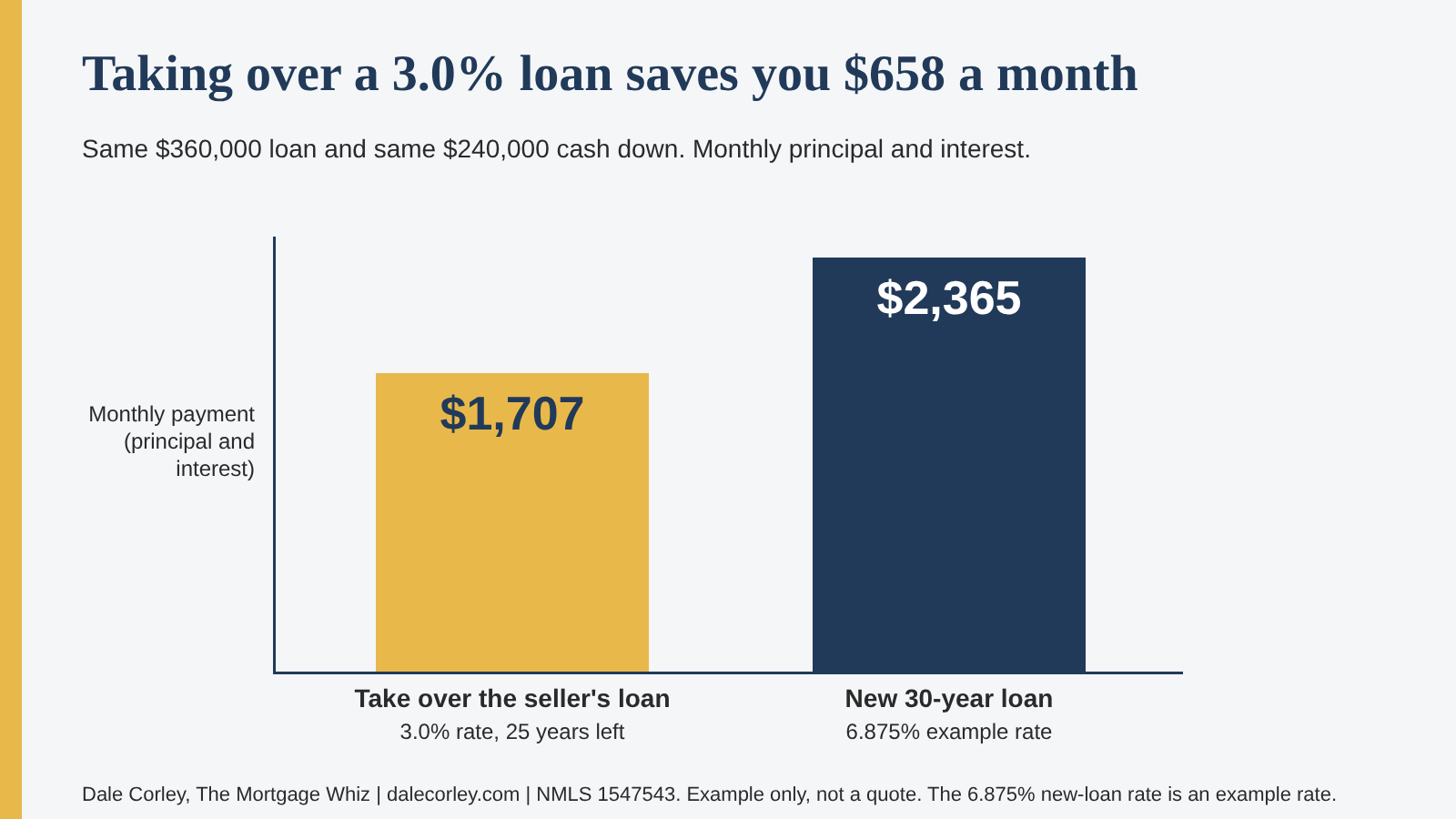
Same $360,000 loan and same $240,000 cash down. The 6.875% new-loan rate is an example rate.
The lower the seller’s rate, the more the assumption is worth. Here is the same loan at other rates.
| Seller’s rate | Monthly payment | You save each month vs. the new loan |
|---|---|---|
| 3.0% | $1,707 | $658 |
| 4.0% | $1,900 | $465 |
| 5.0% | $2,105 | $260 |
| 6.0% | $2,319 | $45 |
At 6%, the saving is only $45 a month, so compare it with a new loan plus a seller credit before you put $240,000 into the home.
How much cash do you need to assume a mortgage?
You need the gap between the price and the loan balance, plus fees. On a $600,000 home with a $360,000 loan, that gap is $240,000, or 40% of the price. That is a bigger down payment than most buyers make, and it is the catch with an assumption. It fits buyers with real cash.
Move-up buyers often use the equity from selling their current home. Others use savings. A HELOC is a credit line backed by a home you own. It can fund the gap, but it changes the math. At the 7.50% HELOC example rate in my Home Equity Playbook, interest only on $240,000 is about $1,500 a month. That is more than the $658 you save, so the assumption works best with cash.
The fees are small next to the gap. For VA, the funding fee is 0.5% of the loan balance, paid at closing and not added to the loan, which is $1,800 on $360,000. The servicer can also charge a processing fee, and VA’s May 2023 circular capped it at $300, so ask for the current amount. For FHA, the servicer may charge a processing fee, so ask for the amounts in writing.
Sellers know a low rate has value. In my experience, some will want it reflected in the price, so don’t assume the gap is fixed.
How does an assumption work, step by step?
- The seller calls their servicer. The number is on the seller’s statement. Ask for the assumption department. For VA, the loan must be current, or be brought current at or before closing. Cash at closing can do it. Never take over payments without the servicer’s written approval.
- You apply with the servicer. Expect the same papers as a new loan, such as pay stubs, W-2s and bank statements, plus a credit check. For FHA, an underwriter, the person who reviews your file, checks you by hand.
- The servicer decides. For VA, the servicer has 45 calendar days after a complete application to say yes or no. For FHA, ask the servicer how long it takes.
- You close. You pay the seller the gap and pay the fees.
- The seller is released. A release of liability is the paper that frees the seller from the loan. For FHA, the servicer prepares HUD form 92210.1 for this. For VA, the assumption includes it. It only happens after the servicer approves you.
Do you have to be a veteran to assume a VA loan?
No. VA’s rule is that a servicer must approve an assumption when the loan is current, you agree to take full liability, and you meet VA’s credit standards.
There is a catch for the seller. When a non-veteran assumes the loan, the seller’s VA benefit, called entitlement, stays tied to that loan until it’s paid off. If you’re an eligible veteran with enough entitlement who will live in the home, you can substitute your own, and the seller gets theirs back. In my experience, a veteran seller who wants to buy another home with a VA loan will often prefer that. My VA loan page explains entitlement in more detail.
How do you find a home with an assumable loan?
You ask. Don’t count on a listing to say. Ask your agent to have the listing agent get the loan type, balance, rate and whether the loan is current, plus a recent mortgage statement, before you tour. My FHA loan page shows what FHA buyers need.
Whiz Advice
- Price the assumption against a new loan with a seller credit or a rate buydown, using the same cash down. My seller credits guide shows how a credit works.
- Make your offer depend on the servicer’s approval. Ask your agent to add an assumption approval contingency, a clause that lets you cancel if the servicer says no, with a closing date at least 45 days out for a VA loan.
- Ask the servicer if it allows a second loan on the home. If you can’t cover the gap in cash, a second loan may fill part of it. Many servicers limit this.
Why use a mortgage broker?
A bank can only offer its own programs. As a broker with NEXA Lending, I’m not stuck with one lender, and I can shop your loan with one application and a soft credit pull option.
I frequently get calls from stressed-out borrowers and their real estate agents looking for urgent help. The closing date is coming fast, and they have just learned from their bank or lender that their loan has been denied. Imagine that added stress and anxiety on top of the already exhausting process of selling, buying and securing financing for a new home.
During our first conversation, I’ll review your two most recent years of tax returns to calculate your maximum qualifying loan amount. If that amount doesn’t get you where you want to be, we’ll talk about a non-traditional loan program that could be a better match to get you the property you want.
Many of the issues that come up in underwriting are guidelines, not a hard stop. If your loan runs into payment shock, thin credit history, or even less than two years of self-employment, an experienced loan officer can often get an underwriting exception using compensating factors.
Qualifying for the loan can be easy. Finding a loan officer with the experience to handle all the nuances is the hard part.
How do you get ready to assume a mortgage?
Here’s what you can do this week:
- Count your cash. Write down your savings, your expected equity and any equity you could borrow against. That is your number for the gap.
- Pay your credit cards down. Get each card under 30% of its limit, and under 10% is better, because the servicer reviews your credit.
- Ask your agent for FHA and VA listings.
- Send me your income and credit details. I’ll tell you if you’d likely qualify, and I’ll run the assumption against a new loan with your price range and the seller’s loan details.
Pick your next step:
- Ready to get pre-approved or refinance? Start your loan application. It’s the fastest way to see your options.
- Have a one-of-a-kind situation? Book a 15-minute call and we’ll talk it through.
- Just have a question? Email me at dale@dalecorley.com with your scenario, and I’ll write back.
I’m a mortgage broker with NEXA Lending, and I work with borrowers in all nine states where I’m licensed (CA, CO, TX, FL, GA, NC, SC, TN, VA). Programs, rates and approval depend on your full file.
Last reviewed November 6, 2026
Sources: VA Circular 26-23-10, VA assumption updates, May 2023, HUD Handbook 4000.1, FHA assumptions, sections III.A.3.b and II.A.8.n, Fannie Mae, changing or transferring ownership of a home, Fannie Mae Servicing Guide D1-4.1-01, USDA HB-1-3555 Chapter 17, transfer and assumption, Freddie Mac Primary Mortgage Market Survey, November 5, 2026, HousingWire, Realtor.com Q2 2026 lock-in data, Oct 23, 2026
Dale Corley | NMLS #1547543 | Licensed in CA, CO, TX, FL, GA, NC, SC, TN, VA | This is not a commitment to lend.