
Business Owners
How to Get a Mortgage in Nashville, Tennessee When You're Self-Employed
Dale Corley · · 8 min read

More homes are coming on the market around Nashville, and that gives self-employed buyers room to negotiate. Redfin’s October 29 report shows Nashville with one of the five biggest jumps in new listings among the 50 largest metros, up 9.1% from a year ago.
Your paperwork decides how much of that you can buy, and the right paperwork can show more income than your tax return does. I’m a mortgage broker, so I shop your loan across hundreds of lenders and you don’t have to.
Key takeaways
- Your tax return counts your profit after write-offs. Bank statements count what came in. The two can differ by thousands of dollars a month.
- I check the cheaper route first, your tax returns, and move to bank statements only if the returns fall short.
- A regular loan goes up to $1,029,250 in Davidson County and five nearby counties. Bank statement loans are not held to that limit.
- I shop your loan across hundreds of lenders so you don’t have to.
On this page: How it works · Why returns look low · One-year returns · Bank statement loans · Loan limit · Monthly cost · Moving to Tennessee · Nuances · Whiz Advice
How do I get a mortgage in Nashville if I’m self-employed?
You prove your income with the right documents. There are two main routes. A regular loan, also called a conforming loan, is one that fits Fannie Mae and Freddie Mac rules. Both routes below can lead to one.
- Tax returns. The standard route, and the one I check first.
- Bank statements. 12 months of deposits, for when write-offs shrink your profit on paper.
My self-employed mortgage guide covers the basics that apply in every state.
Why does my tax return show less than I earn?
Because a smart tax return is built to lower your income. Write-offs for equipment, vehicles, a home office and travel cut your taxable profit, and that is what your accountant is paid to do. The lender then uses the lower number to decide how much you can borrow.
Here is an example. Say your business deposits $342,000 over 12 months, and after write-offs your return shows $84,000 of profit. On paper that is $7,000 a month, even though $28,500 a month came in. A lender who reads only the return sees the smaller number. A bank statement loan reads the deposits.
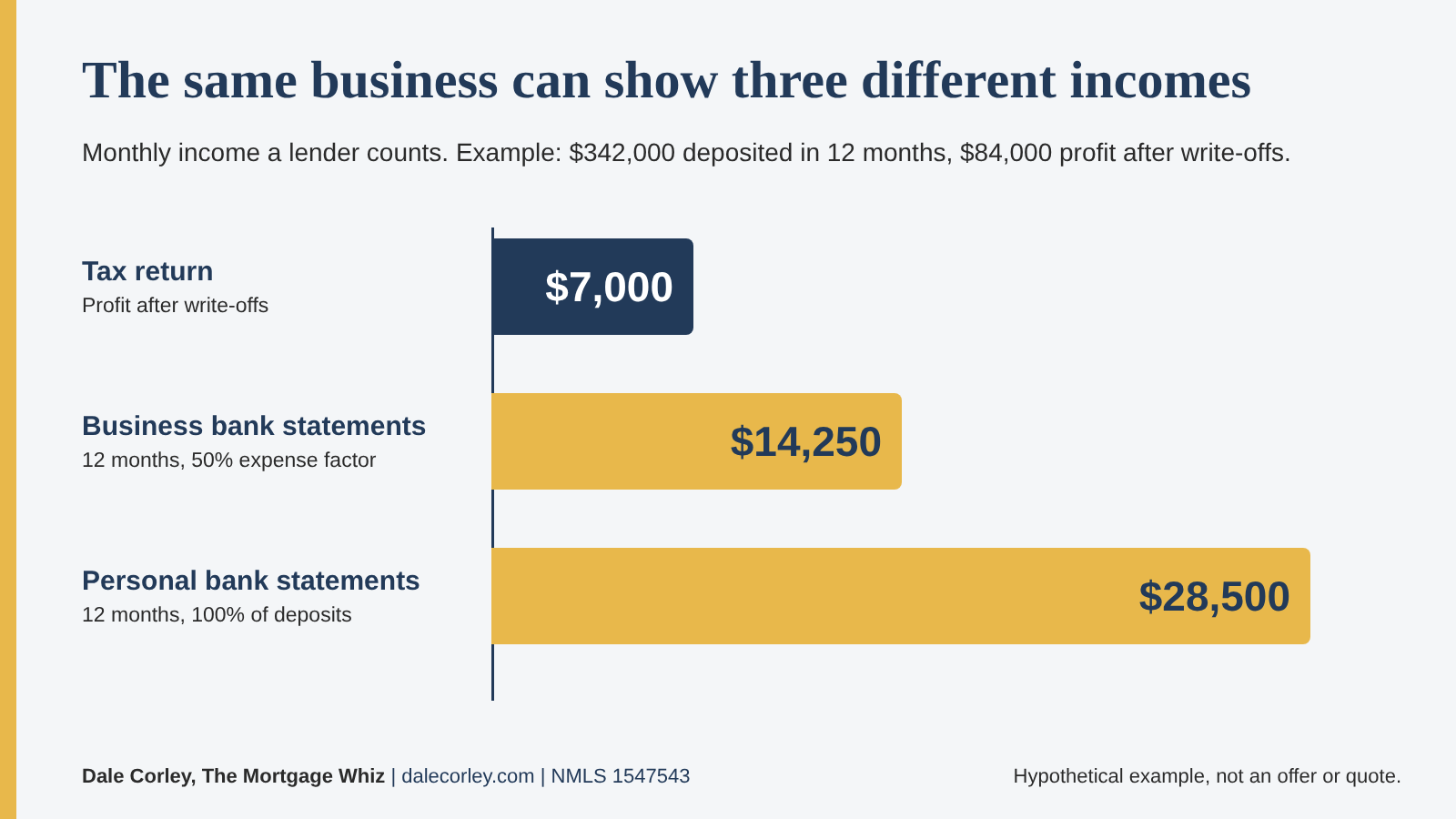
Caption: monthly income counted from the same example business three ways. Business statements use a 50% expense factor.
Can I use just one year of tax returns?
Sometimes, and it’s where I look first. Fannie Mae and Freddie Mac both allow one year of tax returns when the business has been open at least five years. Fannie Mae also requires 25% ownership for those five years. Some write-offs can be added back to your income. Depreciation is one: it is a write-off for the wear on equipment or a vehicle, and it lowers your profit on paper even though you did not spend that cash.
If the returns show enough income, a regular loan is typically the cheapest route.
How does a bank statement loan work?
It swaps your tax returns for your bank statements. Here is the process.
- You send 12 months of statements. Personal or business, from one account. You use one or the other, not both.
- I count the deposits. I add them up and average them by month.
- I shop it. I enter your scenario into my loan search system and compare hundreds of lenders.
- Underwriting reviews the file. Underwriting is the lender’s final review of your income, credit and documents. If a condition looks wrong, I push back before I ask you for more.
- You close. Clean paperwork keeps the file moving.
Here is how the two kinds of statements count, using the example above. Personal statements count in full. Business statements have a share taken out for expenses, called an expense factor.
| Statements used | Share of deposits counted | Monthly income used |
|---|---|---|
| Personal account | 100% | $28,500 |
| Business account, 50% expense factor | 50% | $14,250 |
Most lenders call these non-QM (non-traditional) loans. A Qualified Mortgage, or QM, is the CFPB’s category for a loan with safer features that make it more likely you can afford it. A non-QM (non-traditional) loan sits outside that box but still has to meet the federal ability-to-repay rule. It just proves income with different documents. Because the lender takes on more risk, in my experience the rate typically runs about 1% to 2% higher than a traditional loan, and it varies by file and market.
These loans typically ask for a credit score of about 640 to 700 or higher, 10% to 20% down, and around six months of reserves (cash left after closing). Every lender sets its own numbers, and they change. My bank statement loan guide and bank statement loan page cover the details.
How much can I borrow before I need a jumbo loan?
In Davidson County the regular loan limit for 2026 is $1,029,250, according to the Federal Housing Finance Agency (FHFA). Cheatham, Williamson, Rutherford, Sumner and Wilson counties have the same limit. The standard limit for most of the country is $832,750, so Nashville gets about $196,500 more room.
The limit applies to the loan, not the price. With 10% down, your loan stays under $1,029,250 on a home priced up to about $1.14 million. Above the limit, a loan is called a jumbo loan. The limit applies to regular loans, the tax return route. Bank statement loans don’t use it, so a bank statement loan can go above it. My high-balance conforming loan page and jumbo loan page cover each side of the limit.
What does a Nashville-area home cost per month?
Here are five example prices with 10% down, on a 30-year fixed loan at an example rate of 6.875% in every row, so you can compare prices and not rates. I use 6.875% so the rows stay comparable. For reference, Freddie Mac’s weekly average for a 30-year fixed loan was 7.18% in early November 2026. The payment is principal and interest only, which is the loan payment before taxes, insurance and mortgage insurance. Mortgage insurance, or PMI, is an extra monthly cost on a regular loan when you put down less than 20%. Bank statement loans have no PMI, even with 10% down. These are round example prices, not Nashville medians.
| Home price | 10% down | Loan amount | Principal and interest | Which side of the limit |
|---|---|---|---|---|
| $500,000 | $50,000 | $450,000 | $2,956 | Regular loan |
| $650,000 | $65,000 | $585,000 | $3,843 | Regular loan |
| $850,000 | $85,000 | $765,000 | $5,026 | Regular loan |
| $1,100,000 | $110,000 | $990,000 | $6,504 | Regular loan |
| $1,250,000 | $125,000 | $1,125,000 | $7,390 | Jumbo loan |
A bank statement loan usually carries a higher rate, as I explained above. On the $765,000 row, a rate 1% higher (7.875%) would make the payment $5,547, and 2% higher (8.875%) would make it $6,087. Example only, not a quote.
Redfin also reports that Nashville’s median sale price (the middle home sold) was 3.3% lower than a year ago in late October. That is room to ask the seller for a credit, which is money the seller pays toward your closing costs. On a regular loan with 10% down, the seller can pay up to 6% of the price, about $51,000 on an $850,000 home (Fannie Mae and Freddie Mac limit). Ask for a dollar amount in your offer. A credit usually beats a price cut for the first 12 years or so, and my seller credits guide shows the math.
What if my business is in another state or I just moved to Tennessee?
Moving your business address to Tennessee is rarely a problem. You write a one-paragraph letter that says what the business does and that it is still running, and I help you word it. There is no minimum time at your new address. A business with customers in many places, like consulting, is easier to document than one with local customers, like plumbing.
One thing does trip people up, and it’s a rental or second home they left behind. Say you’re moving from another state and still own a rental there. You leave it off the application because it’s in a different state and a different county. Every property turns up in the lender’s checks, and the added payment can push your debt-to-income ratio (your monthly debts divided by your monthly income) over the limit late in the process. Put every property on the application on day one. This is an example, not a real client.
What nuances do most loan officers miss?
They miss the small things that stall a self-employed file late. Here are the ones I see most.
| What most people think | What I see | Why it matters |
|---|---|---|
| ”I should use my business account.” | Personal statements often qualify you for more. If your spouse is on the account, your spouse must be on the loan too. | One account can qualify you for much more than the other. |
| ”I need a letter from my accountant.” | An experienced bank statement loan officer knows how to clear that condition. | Call me before you chase your accountant. |
| ”Any account will do.” | On a business account, the business name must match the statements exactly. | A mismatch can stall a file late. |
I fight the underwriter before I fight the borrower. If a condition looks wrong, I push back first.
Whiz Advice
Here is how I would play it in the Nashville area:
- Ask for a credit before you ask for a price cut. A $15,000 credit at closing beats a $15,000 price cut for the first 12 years or so, and a credit can also pay for a rate buydown.
- Keep your deposits in one account. Twelve clean months are easy to document. Money bouncing between accounts is not.
- Ask for dollars, not a percent. “$15,000 toward closing costs” is clearer than “3%,” and it is easier for a seller to say yes to.
- Check your price against the loan limit before you offer. Email me the price and I run it both ways, as a regular loan and as a jumbo loan, so you see the difference first.
Why use a mortgage broker?
A bank can only offer its own programs. As a broker with NEXA Lending, I’m not stuck with one lender, and I can shop your loan with one application and a soft credit pull option.
I frequently get calls from stressed-out borrowers and their real estate agents looking for urgent help. The closing date is coming fast, and they have just learned from their bank or lender that their loan has been denied. Imagine that added stress and anxiety on top of the already exhausting process of selling, buying and securing financing for a new home.
During our first conversation, I’ll review your two most recent years of tax returns to calculate your maximum qualifying loan amount. If that amount doesn’t get you where you want to be, we’ll talk about a non-traditional loan program that could be a better match to get you the property you want.
Many of the issues that come up in underwriting are guidelines, not a hard stop. If your loan runs into payment shock, thin credit history, or even less than two years of self-employment, an experienced loan officer can often get an underwriting exception using compensating factors.
Qualifying for the loan can be easy. Finding a loan officer with the experience to handle all the nuances is the hard part.
How do you get ready to buy in the Nashville area?
Here is what you can do this week:
- Gather two years of tax returns and 12 months of bank statements. Email them to dale@dalecorley.com or upload them with your application, and I’ll tell you which route fits.
- Pay your credit cards down. Pay the card with the highest share of its limit first. Aim for under 10% of your limits, and no higher than 30%, so your debt-to-income ratio stays healthy.
- Get pre-approved before you shop. A pre-approval is a lender’s letter that says how much you can borrow. Start your application here. It tells you your price range and makes your offer stronger.
- Put everything on the application and tell me your concerns up front.
- Send me your numbers. My job is to find the loan program that fits your situation best and make sure the application is accurate. The bank statement income calculator is a good place to start.
Pick your next step:
- Ready to get pre-approved? Start your loan application. It’s the fastest way to find out what you can buy.
- Have a one-of-a-kind situation? Book a 15-minute call and we’ll talk it through.
- Just have a question? Email me at dale@dalecorley.com with your scenario, and I’ll write back.
I’m a mortgage broker with NEXA Lending, and I work with borrowers all over Tennessee, including Nashville. Programs, rates and approval depend on your full file. This is educational and not tax or legal advice.
Sources: Redfin, U.S. Home-Sale Prices Just Fell for the First Time in 3 Years, Oct 29, 2026, FHFA, 2026 conforming loan limits by county, Freddie Mac, Primary Mortgage Market Survey, Nov 5, 2026, Fannie Mae Selling Guide B3-3.3-03, Schedule C income, Freddie Mac, Income Calculator FAQ, CFPB, what is a Qualified Mortgage.
Dale Corley | NMLS #1547543 | Licensed in CA, CO, TX, FL, GA, NC, SC, TN, VA | This is not a commitment to lend.